


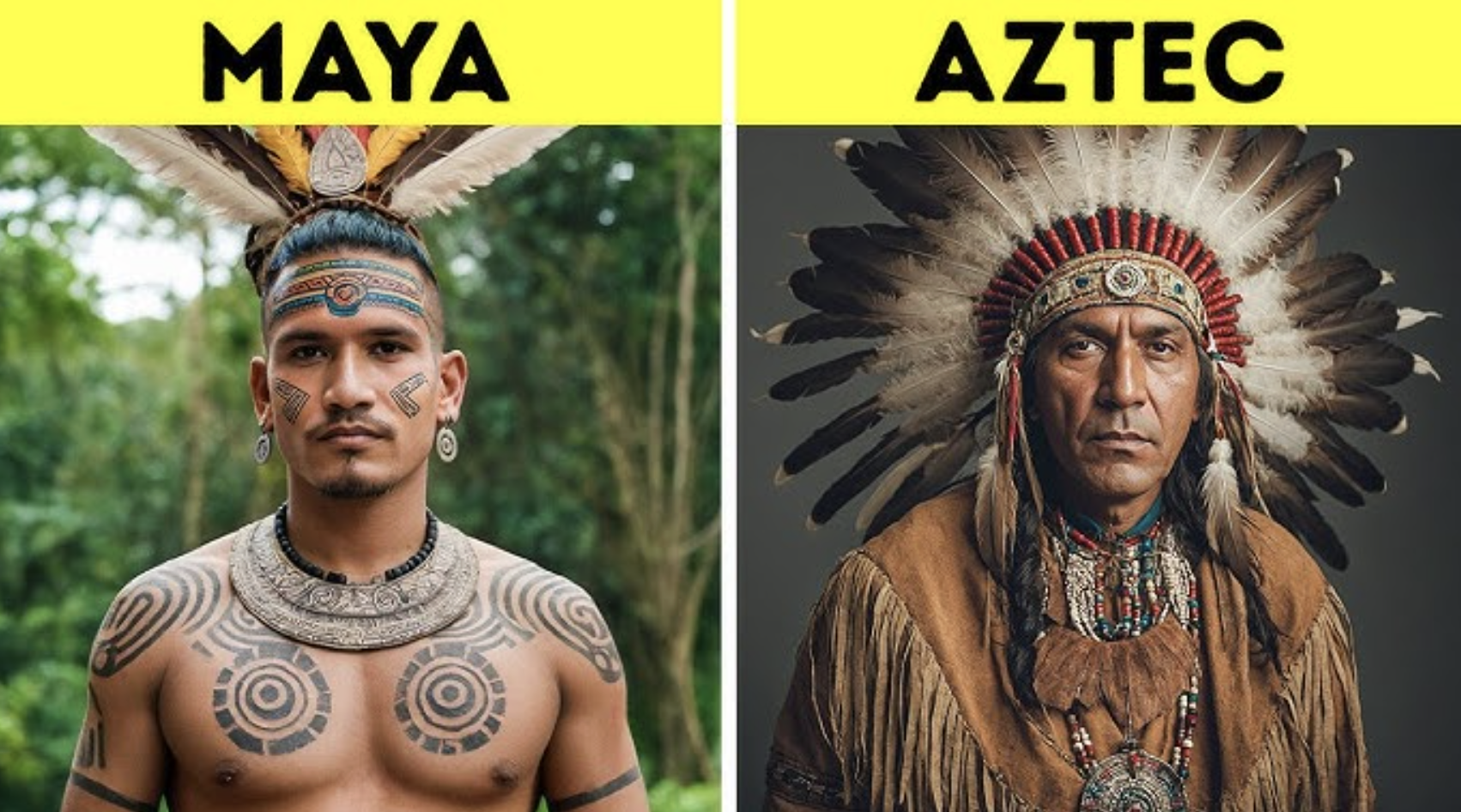
When exploring the rich history of Mesoamerica, two civilizations often dominate the conversation: the Maya and the Aztecs. Both left indelible marks on art, architecture, religion, and culture, but they were distinct in geography, societal organization, and worldview. Understanding their differences offers a clearer picture of Mexico’s deep historical roots and the civilizations that shaped it.
Geographical Differences
The Maya
- Region: Primarily the Yucatán Peninsula, southern Mexico, Guatemala, Belize, Honduras, and El Salvador
- Cities: Tikal, Chichén Itzá, Palenque, Copán
- Landscape: Dense tropical forests and jungles, with cenotes providing freshwater sources
- Environment Impact: The Maya adapted to diverse terrain, building terraces, canals, and reservoirs to sustain agriculture
The Aztecs
- Region: Central Mexico, especially the Valley of Mexico
- Capital: Tenochtitlán (modern-day Mexico City)
- Landscape: High-altitude lakes and volcanic plains
- Environment Impact: Ingenious agricultural techniques such as chinampas (floating gardens) allowed intensive farming in swampy areas
Time Periods
- Maya Civilization: Classic period roughly 250–900 CE, with continued presence until Spanish conquest in the 16th century
- Aztec Empire: Flourished mainly 1300–1521 CE, at the time of the Spanish conquest led by Hernán Cortés
While the Maya civilization began earlier, it experienced a gradual decline in many regions before the Aztecs rose to power in central Mexico.
Society and Political Organization
Maya
- Comprised of independent city-states, each ruled by a k’uhul ajaw (divine king)
- Complex hierarchies with nobles, priests, artisans, and farmers
- Society was decentralized; city-states often fought or allied independently
Aztecs
- A unified empire led by an emperor (Huey Tlatoani)
- Capital Tenochtitlán centralized political and religious power
- Conquered surrounding city-states and imposed tribute systems
Religion and Beliefs
Maya
- Polytheistic: gods related to agriculture, sun, rain, and death
- Practices included human and animal sacrifices, astronomy-based rituals, and calendar ceremonies
- Advanced knowledge of astronomy and mathematics, creating the Maya calendar
Aztecs
- Polytheistic: main gods included Huitzilopochtli (sun and war), Tlaloc (rain), and Quetzalcoatl (feathered serpent)
- Human sacrifice played a central role in maintaining cosmic balance
- Elaborate temples and ceremonial centers, like the Templo Mayor in Tenochtitlán
Architecture and Achievements
Maya
- Step pyramids with temples on top (e.g., Chichén Itzá, Uxmal)
- Sophisticated city planning and water management systems
- Writing system: Maya hieroglyphs, one of the few fully developed scripts in pre-Columbian America
Aztecs
- Tenochtitlán: engineering marvel built on a lake with canals, causeways, and chinampas
- Giant pyramids like the Templo Mayor
- Codices and pictographic writing for record-keeping, though less fully developed than Maya script
Art and Culture
Maya
- Known for intricate carvings, stucco murals, pottery, and jade sculptures
- Focus on astronomy, gods, and rulers in artistic expression
- Music and ball games (Mesoamerican ballgame) were integral to social and religious life
Aztecs
- Masterful stone carvings, featherwork, and jewelry
- Large-scale murals depicting battles, tribute, and gods
- Ritual performance and music central to ceremonial life
Legacy Today
- Maya: Descendants still live in southern Mexico and Central America, preserving languages, textiles, and traditions
- Aztecs: Modern Mexico City sits atop Tenochtitlán; many place names, cuisine, and cultural practices stem from Aztec heritage
Both civilizations influence Mexican identity, from language and food (corn, cacao, chocolate, tamales) to festivals and religious symbolism. They are also central to tourism, archaeology, and education, keeping Mesoamerican history alive.
Key Takeaways
| Feature | Maya | Aztec |
|---|---|---|
| Region | Southern Mexico, Guatemala, Belize, Honduras | Central Mexico (Valley of Mexico) |
| Time Period | 250–900 CE (Classic), lasting until 16th c. | 1300–1521 CE |
| Society | City-states, decentralized | Empire, centralized |
| Religion | Polytheistic, celestial, agricultural | Polytheistic, war-focused, sacrificial |
| Writing | Hieroglyphic, sophisticated | Pictographic codices, less complex |
| Achievements | Astronomy, calendars, pyramids, water systems | Engineering of Tenochtitlán, pyramids, chinampas |
Understanding the differences between the Maya and Aztecs helps us appreciate the diversity of Mesoamerican civilizations. Their ingenuity, spiritual depth, and artistry laid the foundations for modern Mexican culture and continue to inspire worldwide curiosity and admiration.
About the Author
Hi, I’m Matt from Peninsula Properties, your go-to guide for living, investing, and thriving in Playa del Carmen and the Riviera Maya. In 2008 my husband and I quit our jobs in Boston, Massachusetts, sold everything we owned and drove to Playa del Carmen, Mexico to start Peninsula Properties, our property management, vacation rental and real estate company. Now 17+ years later, I am sharing our experience helping expats and property owners navigate the local market. I share honest insights, practical tips, and insider knowledge to make your move—or your investment—a success.
From finding the best schools and maximizing rental income to understanding local regulations and uncovering hidden gems, my goal is to give you clear, actionable advice you can trust. When I’m not exploring the beaches or scouting the newest rental opportunities, I’m sharing stories, guides, and strategies that help you make the most of life in paradise.
Follow along for expert tips, local updates, and everything you need to live, invest, and enjoy the Riviera Maya to the fullest.
Peninsula Properties
Property Management • Rentals • Real Estate
📍 Playa del Carmen, Mexico
🌐 www.nasplaya.com 🔑 Rentals: rentals@nasplaya.com
📊 Ventas: buy@nasplaya.com 🏘 Property Management: bookings@nasplaya.com
✏️ Read the Latest from our Blog
- How to Pay Your Predial in Playa del Carmen (2026 Homeowner Guide)
- How Non-Mexican Residents Get an RFC to Pay Rental Taxes in Playa del Carmen & the Riviera Maya
- Mayan vs. Aztec — Differences, Regions, and Cultural Legacies
- The Meaning Behind Cenotes and Their Sacred Role in Mayan Culture
- Top Cenotes Near Playa del Carmen & Riviera Maya: Sacred Pools of the Maya